Polar Bear Drawing [OLD]
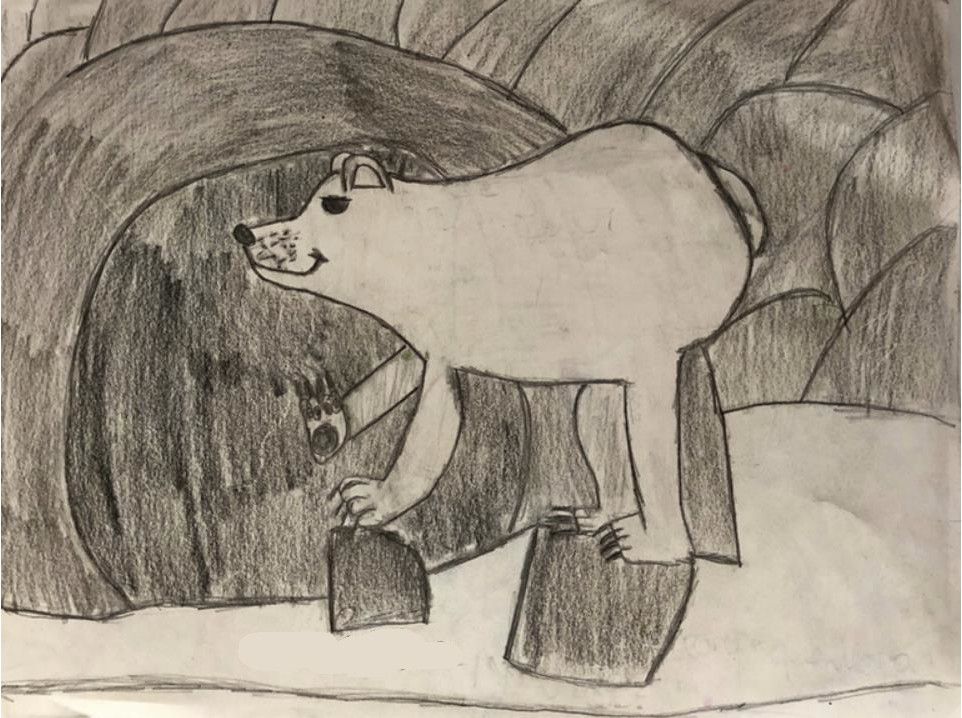
Poorly drawn Polar Bear says hello as he waves at you from some poorly drawn rocks. Behind him is his own cave which...you guessed it is also pretty badly drawn! But it's okay, his entire world is like this so he doesn't really know any better. As you can see, he's happy in this world and apparently can see past the 4th wall to see you (alittle creepy).
Another "Realistic" drawing (or an attempt at it) of a Polar Bear. Because in the journey of every young artist, there comes a moment where you decide to move away from cartoons and finger-paintings and begin to attempt the daunting task of "Realism". This drawing of a Polar Bear represents my first real attempt to try to draw something that look vaguely realistic.
Well my first attempt turned out like you would probably expect for a young child: not too well. Despite not really liking this early one because it's real choppy and odd looking and simple lines (that defined my early style though), especially compared to my other wildlife drawings (even around this time), this was a part of an attempt to make a more realistic wildlife illustration. In other words, this piece was a significant milestone in my creative development.
At the time, the goal wasn't just to draw a bear; it was to understand form, shadow, and anatomy; basically at the part and pieces of the bear without completely becoming the bear. Transitioning from simple shapes to a lifelike creature is one of the hardest jumps for any artist to make, but especially for a little child with determination and a simple crayola set. Even though I personally feel it "failed miserably" by my modern standards, there is a subtle victory here: you can actually tell it's a polar bear! While, like I said before, it still failed miserably but considering it was also my first time making realistic wildlife artwork and at least you can tell it is a polar bear instead of just a vague white blob or even a weird looking white dog; I consider that a win for a first try.
Well my first attempt turned out like you would probably expect for a young child: not too well. Despite not really liking this early one because it's real choppy and odd looking and simple lines (that defined my early style though), especially compared to my other wildlife drawings (even around this time), this was a part of an attempt to make a more realistic wildlife illustration. In other words, this piece was a significant milestone in my creative development.
What makes this piece worth archiving isn't its realistic perfection, but its cute personality. Despite the experimental and somewhat rough nature of the crayon work, the bear itself radiates a sense of pure joy. It's not just standing there; it's waving! This bear is clearly the "life of the party" in its own simple arctic world.
There is something so joyful to its happiness. I like to imagine it's celebrating a successful hunt for a seal or fish as it prepares for it's dinner or perhaps just showing off its' "nice new cave". The cave itself was another experiment in realism-an attempt to create depth and environment behind the main subject. The bear seems genuinely proud of its simple yet homely cave, waving to the viewer as if to say, "Check out this somewhat decent cave I found!" That narrative element-the bear's "waving" greeting-is what saves the drawing from being just a technical exercise and turns it into a character with a true story.
What makes this piece worth archiving isn't its realistic perfection, but its cute personality. Despite the experimental and somewhat rough nature of the crayon work, the bear itself radiates a sense of pure joy. It's not just standing there; it's waving! This bear is clearly the "life of the party" in its own simple arctic world.
Drawing a polar bear for the first time presented some unique challenges me as a young artist, especially when working with Printing Paper, Pencils, and Crayons. How do you define a white animal against a light background? In this piece, I had to rely on "choppy" outlines and crayon shading to create a sense of volume.
The use of standard printing paper at my disposal meant I couldn't layer too much without the paper tearing or becoming overly waxy. You can see the struggle! However, it's was that very struggle-the attempt to make a blunt tool do a sharp job-that makes this archive so interesting to look back on.
Date:2004-2006?
Medium: Printing paper /W Pencil & Crayons
(Note:This piece belongs to my Old archive. Integrating these [OLD] works into my digital gallery allows me to bridge the gap between my childhood inspirations and my modern professional standards, providing a complete timeline of my creative evolution.)